

Repairs vs. Capitalization: What Vehicle Owners Need to Know
When it comes to maintaining motorcoaches and fleet vehicles, one of the most common tax questions we see is:
Should this expense be deducted now—or capitalized over time?
At BUSBooks, we work closely with clients in the transportation and motorcoach industry, and this distinction can have a meaningful impact on your tax position and cash flow.
Understanding the Difference
The IRS separates vehicle-related costs into two categories:
- Repairs & Maintenance → Typically deductible in the current year
- Improvements → Must be capitalized and depreciated
A Simple Framework: The “BAR” Test
To determine how an expense should be treated, we apply the IRS “BAR” test:
- Betterment – Does it improve performance, quality, or fix a defect?
- Adaptation – Does it modify the vehicle for a new or different use?
- Restoration – Does it rebuild or replace a major component?
If the answer to any of these is “yes,” the cost must be capitalized.
Common Examples
Generally Deductible:
- Brake replacements, tires, oil changes
- Windshield repairs or minor body work
- Routine maintenance and minor part replacements
Generally Capitalized:
- Engine or transmission replacements
- Full vehicle retrofits or conversions
- Major system upgrades (HVAC, ADA accessibility features, etc.)
Opportunities to Maximize Deductions
Several IRS safe harbors may allow you to deduct costs that might otherwise be capitalized:
- De Minimis Safe Harbor – Deduct smaller purchases (typically up to $2,500 per item)
- Routine Maintenance Safe Harbor – Deduct recurring maintenance
- Small Taxpayer Safe Harbor – Additional flexibility for qualifying businesses
Why This Matters
Proper classification:
- Impacts your current-year tax liability
- Improves cash flow planning
- Reduces audit risk
How BUSBooks Can Help
We don’t just prepare returns—we help you make informed decisions throughout the year. If you’re planning significant repairs or upgrades to your vehicles, we recommend discussing them with us in advance so we can help you optimize the tax treatment.
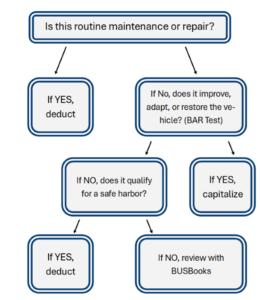
Our Repairs vs. Capitalization checklist and decision tree is included below and may help you determine if you need additional assistance. If you have questions about a recent or upcoming expense, we’re here to help.
Repairs vs. Capitalization Decision Tree
Repairs vs. Capitalization Checklist
Step 1: Identify the Expense
☐ What work was performed?
☐ Is it routine or a major upgrade?
Step 2: Apply the BAR Test
Betterment
☐ Fixes a defect that existed before purchase
☐ Improves performance, efficiency, or quality
☐ Adds a significant new component
Adaptation
☐ Changes the vehicle for a new or different use
Restoration
☐ Replaces a major component (engine, transmission, HVAC)
☐ Rebuilds the vehicle to like-new condition
☐ Repairs after major damage
If ANY box is checked → Capitalize
Step 3: If NOT an Improvement
☐ Keeps vehicle in normal operating condition
☐ Is routine or recurring maintenance
☐ Does not extend useful life
If YES → Deduct as Repair
Step 4: Check Safe Harbors
☐ Under $2,500 per item (De Minimis Safe Harbor)
☐ Recurring maintenance expected multiple times
☐ Within small taxpayer limits